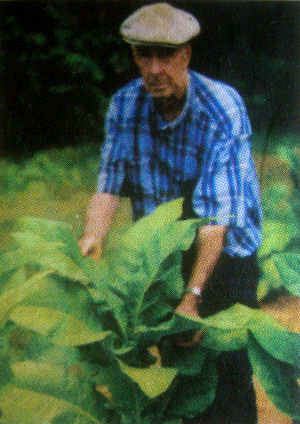
Lewis Gregory, with his prized tobacco.
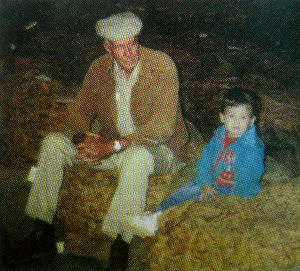
Lewis Gregory and grandson Adam Gregory, during a visit to Motley's Warehouse in Danville.
Lewis Gregory, with his prized tobacco.
Lewis Gregory and grandson Adam Gregory, during a visit to Motley's Warehouse in Danville.
No one well acquainted with Lewis Gregory during his lifetime would be surprised to learn that he preached his own funeral at Shockoe Baptist Church last Tuesday.
In a long letter read from the pulpit by Curtis English, Mr. Gregory detailed to the packed sanctuary his abiding faith in Christ, the importance of being a good neighbor, the lasting impact of generosity and of how much his church and family had meant to him throughout his long life. Pastor Mike Jones offered warm remarks about his friend Lewis, and two local Bluegrass performers offered a lovely rendition of “In His Arms, I'm Not Afraid,” the classic Jim Eanes song of Christian faith.
Mr. Gregory, in view at the altar until his coffin was shut as the service began, was a man of great eloquence. He knew how to use words to say what he meant and how to harness colorful imagery to gird his words with unusual power and humor. (He once spoke of a well-known pessimist as “an apostle of gloom.”) He would have appreciated the stirring manner in which his old friend Curtis English carried out his last request to spread the word.
But no letter, even one from the deceased, could fully capture the unique personality that so many of us have enjoyed for decades. Mr. Gregory's legacy is a curious tapestry woven of stories, historic artifacts, philosophy, pride and a powerful personality that left people either charmed or puzzled.
Countless friends have marveled over his huge, life-long collection of Indian artifacts, his vast collection of coins, his fascinating assortment of locks — including one that takes three men to move. (That's another story.) And bottles upon bottles upon bottles, including even a jar of water from the Mississippi River.
The Gregory house bristles with books on nearly every subject, many of them acquired by his wife Nancy who, forever, seemed charmed by her husband's eclectic interests. In fact, without Nancy, there might not have been the Lewis so many enjoyed. To friends, she seemed to believe that her first duty was to indulge his wide interests. On rare occasions when she was away, their daughter-in-law, Ruth, had to come over each morning to fix his breakfast.
Now, Lewis Gregory certainly could have learned to fix his own breakfast. It tells us something that he chose not to. In our world of people-pleasing chameleons struggling to be all things to all people, Mr. Gregory was a rarity as authentic as one of his cherished Indian artifacts. He said what he thought, and he could be plain-spoken. Once we had stopped to drink a soda at a country store and encountered a man deeply intoxicated. “That fellow was drunk as a boiled hoot-owl,” Mr. Gregory later observed.
He and I enjoyed discussing tobacco in general and cigars in particular. We would trade them for purposes of comparison, though we never smoked together. Yet to behold true ecstasy was to watch Mr. Gregory describe the way in which the smoke of a really good cigar slowly wafted into the nostrils, rising to the loftier levels and bringing the most supreme satisfaction.
But smoking a cigar was a very private affair. “I like to smoke by myself on Sunday afternoons when nobody else is home,”he told me. “You need complete solitude. I even put the cat and dog out.”
He was perhaps best known for the superior tobacco he raised and cured, and his tobacco twists for chewing are works of art. The decline of tobacco was one of his greatest disappointments, and his spirits sagged when he spoke of it. But always innovative, he asked one of his Mexican farm workers to bring him some Mexican corn so he could try growing it in our rich soil. Of course he gave the seeds to friends and neighbors, and late that summer little crops of corn 16 feet tall were growing in more than one backyard.
Once, when Mr. Gregory knew I was headed to Texas to do some work, he asked me to stop by the Barbed Wire Museum in McLean, up in the panhandle, to see if I could procure a type of barbed wire he wanted for his collection. Somehow I returned with the wrong specimen, but he begrudgingly accepted it anyway.
He liked birds and did not like snakes, especially snakes trying to raid birds' nests. He would screw his head around to illustrate how the snake would cock its head and listen for the chirps of baby birds before slithering up a tree. “When I see one with his head cocked, listening,” he would say, “I catch him and cut off his tail…cut it off up around his ears.”
If the world can be divided by the Givers and the Takers, Lewis Gregory was one of the supreme Givers. He presented gifts with the joy of a little boy with his first present for his mother. Whether it was a small jar of picked walnuts, or an oddly shaped piece of lightwood, or a specially carved and engraved cane, his pleasure was so clearly in the giving of it — never in what he might get back for it.
Here on my table as I write is a ruby-eyed serpent made from a piece of lightwood. I don't even recall the circumstances of this gift, but I — like countless people who enjoyed Lewis Gregory — treasure the memento of his friendship.
A hallmark of Lewis Gregory was his intense and wide-ranging curiosity. Blessed with a wondering mind, he saw things he did not understand as puzzles to be worked on and enjoyed. He savored any mystery. On the dark side, this driving force took him to seek out and to observe the procedures of a Kosher slaughterhouse. On the lighter side, he devised ways to attract hundreds of hummingbirds to swirl around him on a summer's afternoon so that he could marvel over one of God's most stunning creations.
With Mr. Gregory, it is impossible to envision his Final Passage without thinking in very literal terms. At those Pearly Gates, surely Lewis tapped on the exterior to see what the gates are made of — and then closely examined the pearls, wondering where they came from and what they might be worth. I suspect he glanced down at his feet, looking for one last arrowhead.
As for St. Peter and the long list, Lewis would surely have wanted to know who among his acquaintances might have just arrived, and how they were holding up in the Final Examination. He no doubt would have asked about his own folks who have preceded him, making certain they got there and that he would soon be seeing them.
When the gates finally swung open, I can see Lewis marching through, head high and looking around in every direction, seeing what he could see. At last, this would be the unlocking of the greatest mystery of them all. And in his mind would be the lingering notes of that old song he so loved, the one he had sung at his own funeral, “In His Arms, I'm Not Afraid.”
This website is sponsored by Mitchells Publications, Chatham, Virginia.