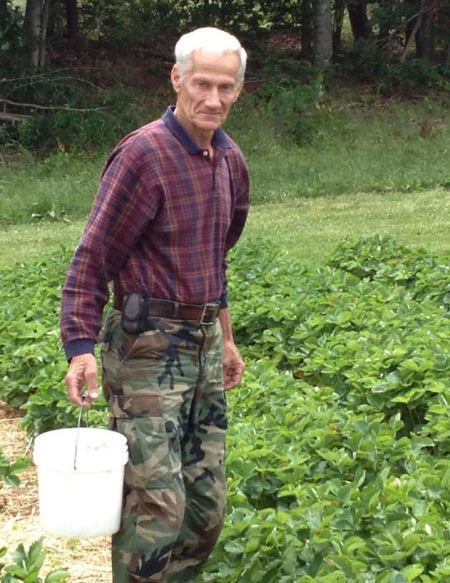
Nowadays Taylor Meadows starts berry picking earlier in the year, in his own cultivated strawberry patch (photo by Taylor Fowler).
Nowadays Taylor Meadows starts berry picking earlier in the year, in his own cultivated strawberry patch (photo by Taylor Fowler).
For me, as with most children of my time, summer was my favorite time of year — mostly, I suppose, because school was out. Even then, we farm children had our daily chores, and also helped our parents with their never-ending work around the house, the garden, and the corn and tobacco fields. During whatever time remained, we children were free to play, or do what children do in their world of make-believe. I was overjoyed to be liberated from the dreaded confines of the classroom, of studying, and of the homework that the teacher would assign us.
How happy I was to be able to roam the woods and streams! As a young boy I always looked forward to the bountiful summer abundance of the wild blackberries and dewberries that grew in neglected fields, provided for free by Mother Nature. One only had to gather them, and I would do so, by the bucketful. Mama would make cobblers from the berries for us children, plus jams and jellies for the coming winter. What treats they both were! What is better on a cold winter's day, than blackberry jam on a hot homemade biscuit?
The blackberries grew on upright canes. The dewberries were on vines that ran along the ground. Blackberries and dewberries are very similar in appearance, but I thought the dewberry was better in taste, a little sweeter than the blackberry. There was a lady in Chatham, Ms. Hankins, who would buy all the berries I could pick for her. She paid me fifty cents a gallon for them, and I thought I was rich with that dollar or two!
The summer wore on, all too rapidly for me, of course. Thoughts of the dreaded school began to creep back into my young mind. Efforts to avoid those thoughts did not work, but I found I could at least divert my thinking to something more pleasant. — The fall of the year was approaching, crops in the fields were winding down, so it would be time for me to prepare for my cold-weather adventure: I would begin repairing old, and making new, rabbit traps. I tramped through the woods, ax in hand, looking for sourwood trees. Many sourwood trees are hollow. I would locate one about as big around as a gallon jug, cut it down and then into sections about three feet in length. I would then carry the sections to our farm workshop and make rabbit traps — or rabbit “gums,” as the older folks called them. When completed, each hollow log trap had a suspended door attached to it. The rabbit's head would hit the trigger as it moved toward the rear of the hollow log where I had placed an apple or onion as bait. When the rabbit hit the trigger, the door would fall downward and close, trapping the rabbit and preventing its escape. When the weather turned cold, I would set a dozen or more of these homemade traps in places where Mr. Rabbit was likely to travel about.
What a thrill it was to get up in the morning before dawn and check my trap line, before eating breakfast and preparing for the bus ride to that “dreaded” school where I was confined for six hours of misery! Daily my traps would snare one or two rabbits for me, sometimes more. I would skin or “dress” them, as some call it. Mr. Shorty Taylor at the Men's Shop in Chatham would buy my dressed rabbits for fifty cents each. He must have really loved to eat rabbit! And once again, I thought I was rich, being paid for what I loved to do.
Looking back now, through an adult's eyes, those were some of the happiest days of my young life. What a wonderful gift God gave to mankind when he gave us the ability to remember, so that as we advance into the sunset years of life, we can step back into those cherished memories of childhood!
This website is sponsored by Mitchells Publications, Chatham, Virginia.