The Spring and the Spring House
Copyright © 2021 Taylor Meadows, Chatham, Virginia. Posted by permission.
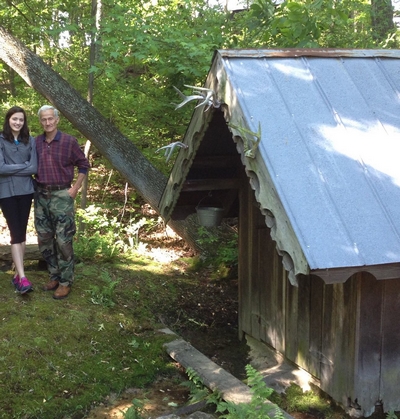
The author and his namesake granddaughter Taylor Fowler stand beside the spring house on his farm. (Photo by Maggie Kapustin.)
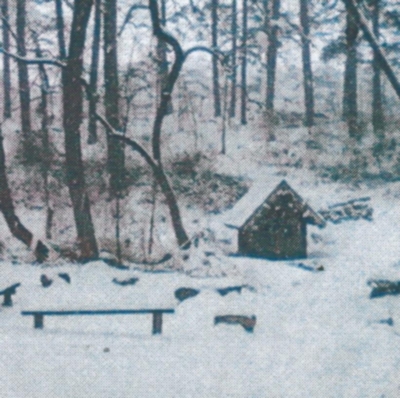
The spring house on a snowy winter day. Many thousands of buckets of water have come from this spring! (Photo by the author.)
As a young boy I was always interested in natural springs of water, and I still am. Most farms had a spring which supplied water for the home and family, and its runoff was a water source for the farm animals. Most springs used for drinking water were kept clean in and around the spring house, and usually a metal or gourd dipper was hanging there for one to get a good drink of cool water.
I carried many a bucket of spring water to our house for drinking, washing, or whatever purpose. It was just one of many chores that farm children did before the coming of rural electrification. Water that had to be carried in buckets to the home was not wasted, in contrast to today, with our unlimited water available at the touch of a faucet. As occurs with many aspects of life in the past, a person in today's world has little concept of the effort required to supply a home and family with lifegiving spring water. — And, sadly, too often the springs themselves are now ignored, neglected, forgotten, or even obliterated for the sake of some desired progress.
A Key Household Appliance
The temperature of spring water as it comes from deep in the earth is around fifty-five degrees. So it maintains a continuous flow, never freezing no matter how cold the outside air gets. In hot weather, springs were also used to keep milk and other perishables from spoiling. Many of the spring houses covering the water's outlet had a shelf made from stones eight or ten inches under water to hold jars of milk and other items to keep cool. Before electricity, the spring house was our natural refrigerator!
Boys Love It
As boys on the farm in the summer, when not helping in the fields of tobacco and corn, in our spare time, usually on a Saturday afternoon, we played in a pool we had created by damming up the runoff a hundred yards or so downstream from the spring house. How happy and carefree we were back then! Once, after playing in our pool, my brother Richard and I came up with the idea of slipping into our father's watermelon patch (he loved to raise big watermelons, and took pride in them). We took the biggest one we saw, which probably weighed forty pounds or more. As the melon had been in full sunlight, it was hot, and needed cooling before we ate it. So we carried it to the springhouse, opened the door, and rolled it into the water. After a couple of hours, we went back to get it out. For two boys around eight and ten years old, that was easier said than done! The watermelon was now both heavy AND slippery, and we could not get it out of the water. Now panic began to set in. We were afraid our father would see us. We had been told never to play in or near the spring house where our drinking water came from. We finally came up with the idea of taking a burlap bag from the corn house and placing it under the watermelon like a sling. Then we would each have an end of the bag to grip. The plan worked. We pulled the watermelon out of the water, carried it down into the woods, and burst it open. It was so big, we only ate the heart of it. I might add that we really didn't enjoy eating it, because we knew we never should have taken it without permission. If we had been found out, I'm sure we would have gotten a peach tree switch whipping, less for taking the watermelon than for putting it in the spring water! I am happy to report that our crime was never discovered, much to our relief.
Bees Love It, Too
Another spring water observation involves honeybees. The bees would light alongside the water amd collect moisture to carry back to their hive in a hollow tree nearby in the woods. I was advised by a neighboring beekeeper to watch an individual bee on the water's edge. He told me that when the bee lifted off into the air, it would fly up a few feet, make a circle, and then the direction it took would be a straight line to the bee tree and its hive not far away. Using his advice, I found a few hollow-tree hives. On one occasion, we attempted to cut down a bee tree to get the honey, but with disastrous results, as one might imagine! We never tried that again!
Two Types of Refreshing
These days, if I see a spring I make a beeline to it, not away from it! I consider springs to be natural treasures, even though few are maintained to be available as a water supply as they once were; I only know of two locally. They refreshed us with clear, cool water. They continue to refresh me with clear warm memories of times that were in some ways more difficult than today, but also happier and simpler.
This website is sponsored by Mitchells Publications.