Spring Garden's Capt. Thomas Fitzgerald Neal, Jr.
World War II Air Ace Died in Battle April 1944
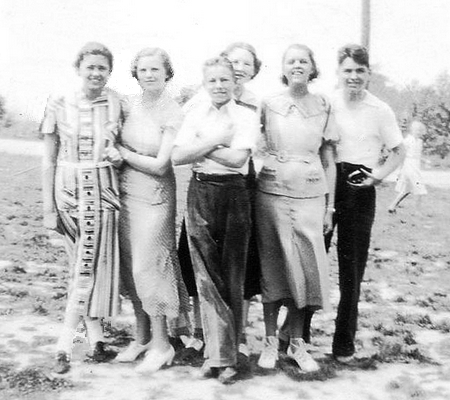
Fitz Neal, Jr., is seen on the far right of this photograph, taken at Spring Garden School in May 1936. The other students in the photograph are, from left to right, Shirley Owen, Dorothy Grove, Ryland Terry, Doris Carter, and Charlee Bryant. (This photograph and the one below are provided by Dorothy Grove Turner and her son Mark Turner, D.D.S.)
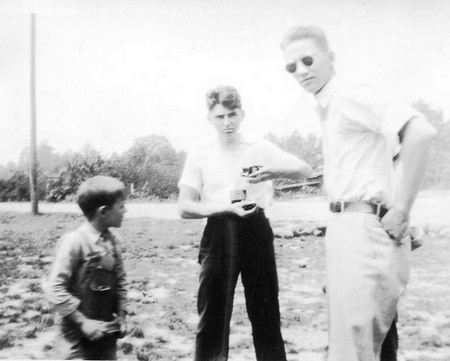
This photograph was taken at the same time and place as the one above. In this image, Fitz Neal is in the center, with his classmate Murry Farmer at right. The young boy at left is thought to be Lynn Rogers. The identity of the device Fitz Neal is holding in both photographs is not known.
Capt. Thomas Fitzgerald Neal, Jr., born and raised at Spring Garden, Virginia, became a celebrated Air Ace in the U.S. Army Air Forces in the European Theater of Operations during World War II. Variously known as “Fitzhugh,” “Fitz,” “Tom,” and “Jeeter,” Capt. Neal was killed in an air battle near Berlin, Germany, on April 29, 1944.
Remembering Fitz, Jr.
Dorothy Grove Turner, who grew up at Spring Garden, and was one class ahead of Fitz Neal at Spring Garden School, remembers his pleasant personality: “He laughed a lot!” She also recalls that he had a high school girlfriend, his neighbor and classmate Shirley Owen. “We only knew him as Fitz” [not any of the other names later associated with him].
Carl Wayne Adams of Java, who grew up as a neighbor of many of the extended Neal family, recalls Fitz Neal, Jr., as “a very intelligent young man.”
Lonnie T. “Tom” Terry, Jr., of Gretna, was one of those Neal relatives living near Carl Wayne Adams. Tom has detailed memories of his second cousin Fitz Neal. Tom's mother Mattie Virginia Neal Terry was first cousin of Fitz Neal, Sr. Besides being a cousin, Fitz Neal, Jr., was a very close friend of Tom's older brother Carroll Terry.
Young Fitz Neal, Carroll Terry, and a third friend Elliott McCormick pursued numerous youthful adventures together, including taking flying lessons at the Danville Airport.
Tom Terry reminisces, “Fitz, Jr., used to come to my house on many Sundays, and often had Sunday dinner with us. Lots of times he would take me on his back and carry me around. He thought so much of children. I had a lot of fondness for him, because he ‘made over me’ more than other relatives did.”
A photograph of Fitz Neal, Jr's Spring Garden High School graduating class of 1937 shows him standing tall on the front row. There he looks far more mature than his sixteen or just-turned-seventeen years, and might easily pass for a faculty member.
Dorothy Grove Turner recalled that upon graduation, Fitz Neal went to Cumberland College in Kentucky. That school's records show that he was a student at Cumberland for two semesters beginning in the fall of 1937, comprising his freshman year, after which he did not return.
The Fitz Neal family, like almost all of their Spring Garden neighbors, were tobacco farmers. A May 18, 1944 newspaper article in the Greensboro Daily News reported that Fitz Neal, Jr., had worked in a store in Chatham. But whatever his educational and vocational activities were, it was his airborne hobby that provided the foundational skills for his later military heroism.
News from the Front
A Chatham newspaper in 1943 carried the headline “Lt. ‘Jeeter’ Neal Becomes an Ace: Pittsylvania County Airman Shoots Down Fifth Plane Over Europe.” The article, apparently constructed from an Army information office dispatch, asserted that “the 23-year-old Mustang pilot has won the nickname ‘The One-Man Gang.’ ” He later was credited with a sixth air victory.
In early April 1944, another Army dispatch featuring Fitz Neal was printed in newspapers throughout the United States. The Richmond Times-Dispatch headlined it “Fighter Pilot: No Longer the Boy You Knew in those Days of Peacetime.” The Kansas City Star titled it “Changed by Dangers: Despite Horseplay, Pilots are Sobered and Matured. — Know Death Threatens but Rarely See Men Die and Never Expect It to Happen to Them.” The article highlighted several U.S. fighter pilots based in England. The article described their being grounded for the day due to bad weather, and while awaiting better conditions they were unwinding in their unit's Quonset hut operations office. A radio played recordings broadcast by the American forces network. Jeeter Neal was described as providing well-received impromptu entertainment for the gathering by jitterbugging alone, then later vocally mimicking swooning girls when a Frank Sinatra song played.
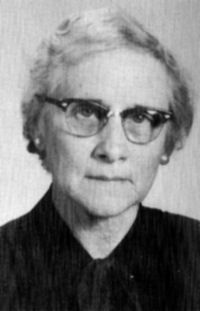
Capt. Neal's mother Helen Conway Neal (the image is from the 1956 yearbook The Mirror at Spring Garden High School, where she was an elementary teacher).
Tom Terry, reflecting on the account of Capt. Neal's jitterbugging in England, says, “Fitz, Jr., was known in the Spring Garden community as quite a good dancer. I later did a little jitterbugging myself, so I was aware of his reputation. And his sister Emily also was a superb dancer. I remember that from around the time she was finishing high school.”
Later that month the news of Capt. Neal turned from lighthearted to deadly. Missing Aircrew Reports declassified in 1973 give the following details. On April 29, 1944, at 8:43 a.m. Capt. Neal took off in his P-51 Mustang with the 354th Fighter Squadron to protect a bomber flight headed for Germany. About 10:45 a.m. they were approximately thirty miles southwest of Berlin when four German Focke-Wulf Fw 190 fighter planes emerged from the clouds below them. Captain Neal and his wingman Second Lieutenant Herbert Fritts peeled their planes off the formation and went after the 190s in a vertical dive at 450–500 miles per hour, soon chasing two of the German planes to near ground level. In violent maneuvering during which Fritts briefly lost then regained consciousness, Fritts lost contact with Neal. Fellow squadron members circled the area for about an hour unsuccessfully trying to reestablish radio contact with him.
The above-mentioned Greensboro news article on May 18 headlined, “Top-Ranking Virginia Pilot Reported Missing in Action.”
The Deep Sense of Loss
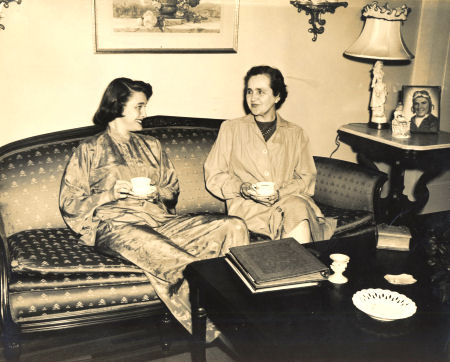
Capt. Neal's first cousin, actress Patricia Neal, with their Aunt Maude Neal Mahan during the Christmas holdays of 1950. A portrait of Capt. Neal sits on the table at right. (The photograph was taken by Don Bloomquist in December 1950. Several other images taken at the same time were used to illustrate a feature article by Frances Hallam Hurt. The photograph is from the private collection of Henry C. Hurt.)
Tom Terry recalls that he was an early elementary student at Spring Garden High School, and his teacher was Helen Conway Neal, mother of Capt. Fitz Neal. “Cousin Maude Neal Mahan [Capt. Neal's aunt] and another person — I don't remember who he was — came to the classroom door. Helen stepped out to talk to them, and that's when she got the official news that Fitz, Jr., was dead. Helen stepped back into the classroom to pick up a thing or two, then left for the day. A high school student came down to our class to be our substitute teacher. The next day Helen was back in the classroom, but she never spoke of Fitz, Jr.'s death to us.”
“Helen was a wonderful teacher. She made everything so easy in the way she presented it.”
Thirteen years later Henry Mitchell, now of Chatham, was a student in Mrs. Neal's fifth grade class at Spring Garden, and he wholeheartedly agrees. But he offers one observation that was different regarding that later era: “Yes, Mrs. Neal did mention to us her son's combat death to us. She was brief and matter-of-fact about it.”
Tom Terry comments, “When I got the word of his death, I couldn't accept it. And Fitz Neal, Sr., was certainly affected by Fitz, Jr.'s death. I saw less and less of him out in public as time went by.”
Capt. Neal's first cousin, actress Patricia Neal, was an eighteen-year-old sophomore at Northwestern University in Evanston, Illinois. In quick succession she experienced the sudden death of her father from a heart attack, and then two Army death notifications. She heard about her cousin Fitz's death while she was at Northwestern. She was working in summer theater in Pennsylvania when she was notified of the death of her boyfriend, Lt. Frank Ball. In her 1988 autobiograhy As I Am she says that after she heard about “my brave lieutenant, my beautiful Frank … I cried for months. … My cousin Fitz Neal, Jr., had been shot down in his tiny plane. I wept for them [Frank and Fitz] and for Daddy and for the unfairness….”
In her compounded grief, she did not return to Northwestern, in spite of her Aunt Maude Neal Mahan's offer to pay her college costs. Instead, Patricia turned her distress into a serious effort to launch a professional acting career in New York, which obviously turned out splendidly.
A photo of Patricia Neal in late 1950 shows her sitting with her Aunt Maude Mahan, at Mrs. Mahan's home near the Neal home on the Spring Garden Road. On a table beside the sofa sits a portrait of uniformed Capt. Neal, his flight goggles pushed back on his forehead.
In 1953, Patricia Neal married famed British writer Roald Dahl, who in World War II had been an RAF fighter pilot and Air Ace.
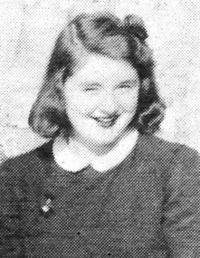
Capt. Neal's sister Emily (the image is a detail from a photograph of her 1943 senior class at Spring Garden High School, from the 1964 yearbook The Mirror).
Capt. Neal's bright younger sister Emily was also a college student, a seventeen-year-old freshman, when the news of his death came. Emily, like her cousin Patricia, was gifted in writing and the performing arts. During her high school years she participated by invitation in Averett College's journalism and drama activities. She was graduated with honors and a two-year degree from Cumberland College (the school her brother had earlier attended) and then moved on to Longwood College. There her academic career apparently stalled. Her acquaintances said that she had a “nervous breakdown.” Her condition was attributed to the trauma of her brother's death, complicated by her disorientation regarding her cousin Patricia, who arguably had been the closest-to-sister she had. Emily and Patricia had been close as young first cousins, with similar interests and achievements. Patricia's almost-overnight vault to the pinnacle of Broadway and Hollywood acclaim was an act that Emily could not follow (in several senses) — and, of course, neither could anyone else. Patricia Neal herself, talking to Frances Hallam Hurt in 1950, called her own sudden success “Ridiculous, ridiculous, ridiculous.”
Whatever the causes, Emily's crash was extreme. Afterward she seldom spoke. Today she would probably be diagnosed as a victim of post-traumatic stress disorder (“PTSD”), with dissociative aphasia, but it would be several decades before such conditions would be named, much less treated. Around 1950 she also suffered grand mal seizures, but neither the cause nor the extent of the seizures is known.
In spite of her deeply distressed state, or maybe because of it, in 1958 Emily published a book New Sparks of Life: Some Reflections and a Few Poems, printed by Whittet and Shepperson in Richmond. The first part of the book is “Reflections on World War II,” an essay which Emily described as “Inspired by and dedicated to my only brother, Fitz Neal, Jr., who gave his life for his country during this conflict in the European Theater.”
Henry Mitchell recalls that Emily seemed to be comforted by being in the presence of his mother, artist Mary Mitchell. “Emily would walk the half mile along the Spring Garden Road to our house. She would usually enter without knocking, and would wander through the house until she found Mom. Mom would typically be in her art studio, painting, or in the kitchen, preparing a meal. Whichever it was, Emily would sit on a stool as close to Mom as she could get and watch her work. Mom would talk to her as though Emily were answering, but Emily almost never said a word. Sometimes we would come back after being away from home — in those days we did not lock our doors when we were away — and Emily would be sitting silently in our living room, rocking, waiting for Mom to get back. A few times she would eat a meal with us, but usually when a meal was ready she would simply get up, walk out the door, and head for home. And at other times, if we were eating in the kitchen in the back part of the house, Emily would slip quietly in the front door, unnoticed by us. She would go into the living room in the front of the house and begin to play our piano. She was quite skilled. We would just laugh at being startled, and say to each other, ‘Emily's here!’”
After her mother's death in 1990, Emily was a resident at the Gretna Health and Rehabilitation Center. Carl Wayne Adams and his wife Doris Farris Adams often visited her there. At one point Doris encouraged Emily to play the piano which sat in a meeting room at the facility. “The staff all came in and marveled. They had no idea that Emily had such a talent,” Doris recalls. “Up until that time, they had only known Emily as living in a withdrawn, almost zombie-like state.” Carl Wayne adds, “After that, Emily would take us down to the piano room so she could play for us.”
In music, Emily followed her mother's example. Helen Neal was the only teacher at Spring Garden School who provided and maintained her own piano in the classroom. “Her piano was a lot better instrument than the two or three in the building that were school property,“ says Henry Mitchell, who as one of Mrs. Neal's fifth graders was taking piano lessons from Verona Whitlow “in the music room upstairs.” Back downstairs in the fifth grade classroom, “Every day Mrs. Neal led us in several songs, all from paperback songbooks. She made sure her students were familiar with, and could sing, a variety of music — traditional, inspirational, and humorous novelty ditties. Most elementary teachers included singing in the daily class activities, but with Mrs. Neal accompanying us on piano, it was a lot more effective. It seems to me that every day we sang one or more patriotic songs. I wonder now if that was a way she was expressing her feelings about her family's sacrifice.”
Further reviewing his memories of the Neal family, Mitchell says, “During my growing-up years in the 1950s and 1960s at Spring Garden, everyone seemed to speak of Fitz Neal, Jr., almost with hushed reverence. From all accounts, he was a strikingly handsome young man of remarkable personality and promise. His wartime achievements and early death left the whole community with a deep sense of loss.”
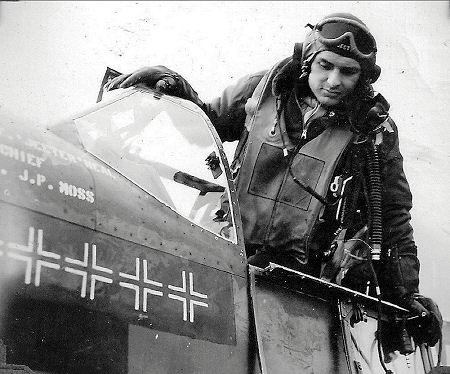
Capt. T. Fitz Neal, Air Ace, U.S. Army Air Forces, in his P-51 Mustang. Eventually six crosses on his fuselage indicated the number of German planes he had downed. (The image is provided through the research assistance of William D. Wheeler, volunteer at the Virginia War Memorial, Richmond, Virginia.)
Toward Winning
Deployment of the faster, more powerful, higher-flying P-51 Mustang, one of which Capt. Neal piloted, was a significant turning point in World War II. American air strategy had previously depended on the use of bombers with defensive gunnery onboard, and accompanied by a small defensive force of fighter planes. The results over Europe were disastrous, with horrendous loss of Allied planes and life and leaving Germany in control of European airspace. With the P-51, American air forces went on the offensive, now able to not merely defend bomber planes, but to aggressively destroy the German air forces. Capt. Neal and his fellow pilots quickly invented new tactics and achieved a spectacular turnaround, making possible the success of the D-Day invasion and eventual defeat of Germany.
Involving Pittsylvania County's Military History
Capt. Neal was one of numerous examples of extraordinary accomplishment and heroism by World War II combatants from Pittsylvania County. Many of these individuals had grandfathers or great-grandfathers who had fought in the Civil War — and, in turn, often those again had grandfathers or great-grandfathers who had served in the Revolutionary War — as well as in other military circumstances and events.
In Capt. Neal's case, his great-grandfather Abram Thomas Neal was a member of Company G, 53rd Virginia Infantry, under the command of Capt. Ross Carter of Chatham. Abram Neal was severely wounded in Pickett's Charge at Gettysburg.
Notes
- The air war over Europe claimed the life of another local fighter pilot three months after Capt. Neal's death. On July 24 First Lieutenant Charles Hobson Viccellio of Chatham was wounded in action and died two days later.
- See further regarding the P-51 Mustang, among many other references:
- See also the account of Capt. Neal's boots.
- A more detailed description of Abram (or Abraham) Neal's Gettysburg experience is seen at the Neal family website NealManor.com, and additional information regarding his military service is seen at the FindAGrave.com listing for his grave.
- Further information regarding Pittsylvania County military history can be found at:
- Capt. Fitz Neal and Patricia Neal's grandfather was William David Neal, son of Abram Neal. Researcher Aubrey Bennett provides brief notes on Fitz and Patricia's immediate ancestral family:
- William David “Willie” Neal was born 16 Sept 1866, the son of Abram Thomas Neal and Mary A. E. Owen, He died 19 Nov 1946. He was married 23 Nov 1890 to Mary Lou “Lucy” Fitzgerald; they had 6 children, listed below. After Lucy died, Willie married Mollie Cox.
- Thomas Fitzgerald Neal, born 15 Dec 1891, died 26 Nov 1966, married Helen Conway on 1 Mar 1913 in Yanceyville, North Carolina. (Her parents were James A. Conway and Callie Shields Conway.) Fitz and Helen Neal had two children: Capt. Thomas Fitzgerald Neal, Jr., and Emily Conway Neal.
- Mary Maude Neal was married in 1911 in Williamsburg, Kentucky, to William Milton Mahan, who died in 1938. His family owned Southern Coal and Coke Company, Packard, Kentucky. Maude moved back to Pittsylvania in 1946. Maude and William Mahan had one child, William Breckenridge Mahan, born 6 Mar 1913. He married Dorothy Dishman; they had no children.
- William Burdette Neal married Eura Mildred Petry. They had three children: Margaret Ann Neal, Patsy Louise “Patricia” Neal, and William Petry Neal.
- Hugh Downey Neal, born 1898, never married. During World War I he was working in shipbuilding in Newport News, and died in 1918 of meningitis. He is burried at the Neal family cemetery on Slatesville Road near Shockoe.
- Douglas Neal probably died young.
- Eben Rexford Neal also never married, and lived with Maude.
- Thomas Fitzgerald Neal, Jr., entered Cumberland College in 1937 and was a student for two semesters. His sister Emily Conway Neal entered Cumberland College September 4, 1943, and she was graduated June 4, 1945. (Information provided by Leah Gray, Office of the Registrar, University of the Cumberlands, Williamsburg, Kentucky).
- Information regarding Patsy Louise “Patricia” Neal at Northwestern University was provided by Charla Wilson, Archivist for the Black Experience, Northwestern University Libraries, Evanston, Illinois.
- Capt. Neal and his immediate family are buried at Highland Burial Park in Danville (see FindAGrave.com): Thomas Fitzgerald Neal, Sr. (December 15, 1891 – November 26, 1966); Helen Conway Neal (August 18, 1894 – July 4, 1990); Thomas Fitzgerald Neal, Jr. (May 5, 1920 – April 29, 1944); and Emily Conway Neal (June 1, 1926 – December 1, 1992).
- Besides the above-quoted and credited individuals, research and editorial assistance was provided by James Brooks; Joan Mitchell Keith; Patricia B. Mitchell; Sarah E. Mitchell; Mark Turner, D.D.S.; and Julia Atkinson Gatewood.
This website is sponsored by Mitchells Publications, Chatham, Virginia.